

Lot n° 115
Estimation :
5000 - 10000
EUR
Alphonse de Lamartine - Lot 115
Alphonse de Lamartine
"Haute-Combe"
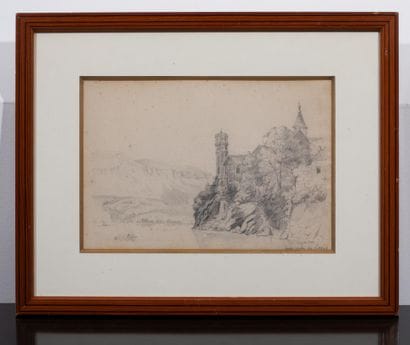
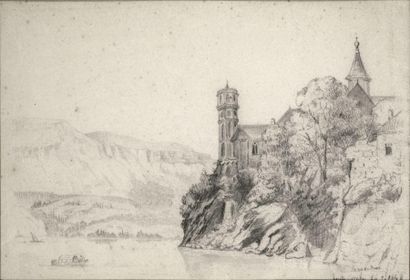
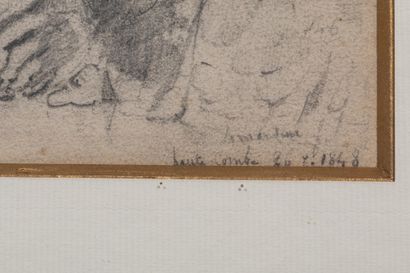
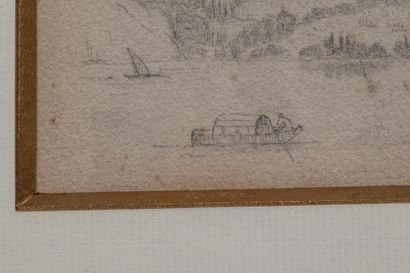
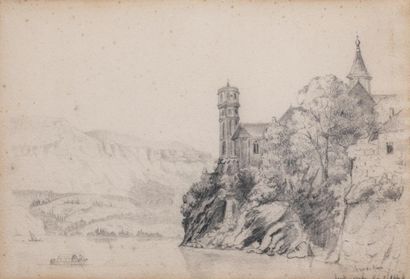
Original drawing, with autograph date "48" in the rock at lower right, and with handwritten caption "Lamartine. Haute-Combe 20. 7 [?]. 1848". Graphite, 19 x 27, 5 cm, some spotting, framed under glass.
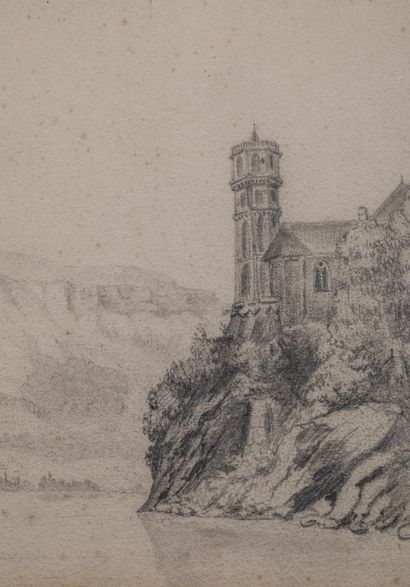
Hautecombe Abbey, one of the most picturesque views of Lac du Bourget: shown here from the shore, with Mont de Corsuet in the background.
Lamartine's poem "Le lac", emblematic of early Romanticism, immortalized Lac du Bourget. During a cure at the waters of Aix-les-Bains in October 1816, Lamartine had met Julie Charles, a young woman married to an elderly man, with whom he fell deeply in love and whose salon he frequented from January to May 1817. Returning to the shores of Lac du Bourget in August 1817, he waited in vain for Madame Charles, and wrote the famous elegy "Le Lac", published in 1820 in Méditations poétiques:
"[...] O lake! the year has barely ended its career,
And near the cherished waves she was to see again,
look! I come alone to sit on this stone
Where you saw her sit! [...]
One evening, do you remember? We sailed in silence;
All you could hear in the distance, on the waves and under the skies,
Only the sound of oarsmen striking in cadence
Your harmonious waves.
Suddenly accents unknown to earth
From the charmed shore struck the echoes:
The flood was attentive, and the voice dear to me
Dropped these words:
"O time! Suspend your flight, and you, propitious hours!
Suspend your course:
Let us savour the swift delights
Of the most beautiful of our days! [...] "
In his autobiographical novel Raphaël (1849), Lamartine again evoked Lac du Bourget and the great love of his youth:
"[...] The Mont du Chat, more naked, steeper and harsher, plunges its rocky feet sheer into the water of a lake bluer than the firmament where it plunges its head. This lake, some six leagues long and varying in width from one to three leagues, is deeply incised on the French side. On the Savoy side, on the other hand, it insinuates itself unobstructed into coves and small gulfs between hillsides covered with woods, trellises, high vines and fig trees, which dip their leaves in its waters. As far as the eye can see, it ends at the foot of the Châtillon rocks, which open up to let the lake's overflow flow into the Rhône.
The Abbey of Haute-Combe, tomb of the princes of the House of Savoy, rises on a granite buttress to the north, and casts the shadow of its vast cloisters over the waters of the lake. Shielded from the sun all day by the wall of Mont du Chat, the darkness surrounding this edifice is reminiscent of the eternal night, whose threshold it is for those princes who have descended from the throne into its vaults. Only in the evening does a ray of the setting sun strike it and reverberate for a moment on its walls, as if to show men the port of life at the end of the day. A few sailless fishing boats glide silently along the deep waters beneath the mountain cliffs. Their old-fashioned planking makes their color a mismatch with the dark hue of the rocks. Gray-feathered eagles hover ceaselessly over the rocks and boats, as if to compete with the nets for their prey, or to swoop down on the fishing birds that follow in the boats' wake along the shore. [...] "
Bibliography
- DESSINS D'ECRIVAINS. Paris, Éditions du Chêne, 2003. Reproduction p. 11.
My orders
Sale information
Sales conditions
Return to catalogue